

Behind the Lecture pulls back the curtain on some of Dal’s most compelling courses, offering a closer look at the ideas and people that shape them.
Contrary to what the title of this series suggests, participants in the intensive two-week course don’t actually spend much time in classroom lectures — they’re too busy traveling across Nova Scotia to explore the science behind where two essential local industries cross over.
Agroforestry refers to the traditional practice of combining forestry and farming on the same piece of land for maximum ecological, environmental, and economic benefits. Dalhousie’s course on the topic, which is part of the popular SEASIDE Program’s range of experiential learning courses, most recently ran from April 29-May 14. It provides a small group of students (enrolment was capped at 14) a better understanding of how trees and crops interact for light, water, and nutrients, and how agroforestry improves soil fertility, nutrient cycling, and conservation.
“With the increasing global demand for food and the parallel need to expand land and marine conservation areas, agroforestry represents one of the few sustainable land-use practices capable of addressing both objectives simultaneously,� says Professor Rajesh Rajaselvam, a University Teaching Fellow in the Department of Biology who has served as the course’s sole instructor since introducing it in 2013.
While the course involves extensive data collection and analysis — time on campus is primarily spent in the lab — the best way to discover the benefits of agroforestry is to hear first-hand from farmers with decades of experience.
Suggest a course for Behind the Lecture

Is there a compelling or innovative Dalhousie course more people should know about?
Students, faculty and staff are invited to share suggestions for future Behind the Lecture articles.
Students visited Point Pleasant Park, Rose Briar Farm in Shubenacadie, and Haskap farms in Colchester County and Elderbank to see agroforestry in action. Haskaps — a flavourful “superberry� boasting more antioxidents than blueberries and high vitamin C content — are native to Japan but have adapted well to Nova Scotia’s climate due to similar latitude and growing conditions, notes Gwendolynn van Veen (BSc’25), head teaching assistant for the course.
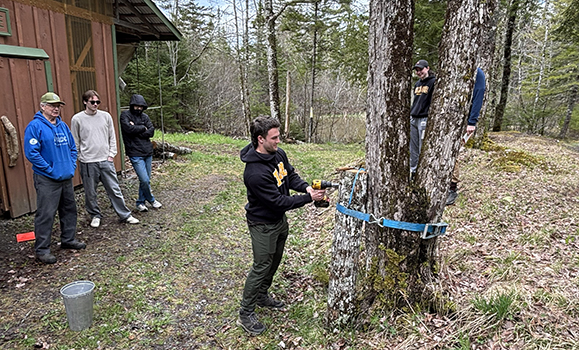
A student bores into a tree at Rose Briar Farm to prepare it for maple tapping
During their visits, students asked questions and gained insight into various aspects of crop management, such as pruning, pest management, soil fertility, harvesting, and proper mixed cropping. “Field experiences like this allow students to see real-world applications of what they have only discussed as concepts in class, making learning much more meaningful,â€� says van Veen.Â
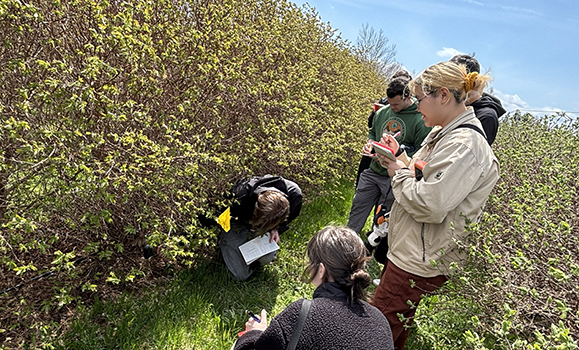
Students take nutrient and environmental readings with nutrient, pH and moisture content meters at a Haskap farm in Nova Scotia
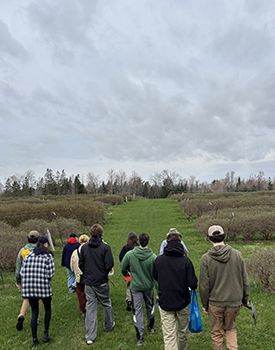 Soil samples were also collected for analysis back at Dal for nitrogen, phosphorus, and potassium (NPK), key nutrients for happy and healthy plant growth. These results allowed them to explore potential management strategies that could be used to optimize soil health and growing conditions, adds says van Veen.
Though there is a lot to absorb in just over two weeks, students gained a lot from getting outside of the classroom.
“I found it especially interesting that agroforestry focuses not only on environmental sustainability, but also on improving the economic pilipiliÂþ» of agricultural and forestry systems,â€� says undergraduate student Shayla Martin. “The hands-on field and lab experiences were my favourite aspects of the course. Being able to collect data and apply concepts to real-world settings helped me learn the material on a much deeper level than simply studying for an exam.â€�
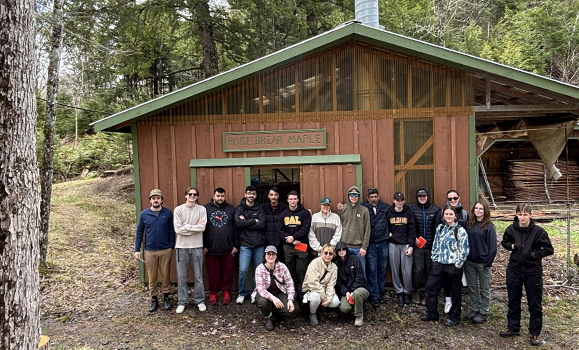
Rose Briar Farm in Shubenacadie was along the sites visited in BIOL 3634: Agroforestry