
David Schroeder Music & Culture Lecture Series
Explore how music shapes history, identity, and society through Dalhousie's 2026 David Schroeder Music and Culture Lecture Series. Engage with leading scholars and artists, discover new perspectives, and connect classroom learning to the world around you.
Join the Fountain School community for inspiring conversations that invite curiosity, challenge assumptions, and celebrate the power of music and culture.
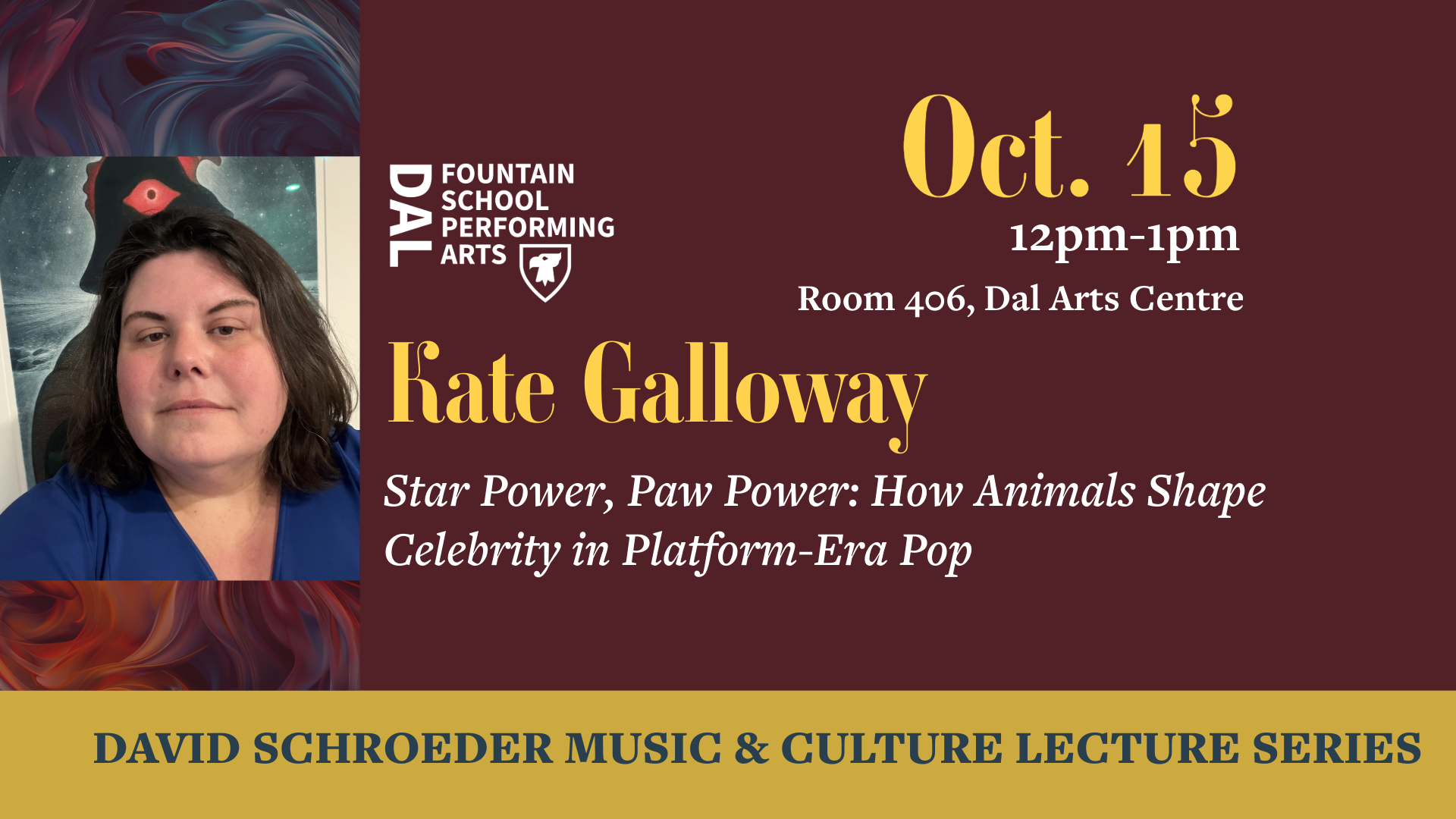 Star Power, Paw Power: How Animals Shape Celebrity in Platform-Era Pop
-with Kate Galloway
Oct. 15 | 12:00PM-1:00PM
Room 406, Dalhousie Arts Centre
free and open to the public
What do pop stars’ pets have to do with celebrity culture? More than you might think. Star Power, Paw Power explores the role of animals in contemporary pop stardom, asking how human and animal identities become intertwined in the platform era.
Join Kate Galloway at the Fountain School’s David Schroeder Music & Culture Lecture series and explore how animals help build celebrity identities, generate affect, and circulate star power across social media, music, and popular culture.
From Taylor Swift, Sabrina Carpenter, Olivia Rodrigo, Rufus Wainwright, and other contemporary stars, Kate Galloway examines how pets move across Instagram, TikTok, music videos, merchandise, interviews, and fan cultures to become part of a celebrity’s public persona. Consider what happens to ideas of fame, authenticity, intimacy, and fandom when celebrity becomes multispecies.
Examine how affect—affection, attachment, familiarity, and connection circulates among stars, animals, fans, and platforms, shaping the construction and circulation of star persona in the social media age. Along the way, we’ll ask: Who gets to be a celebrity, and what does an animal bring to the story?
Kate Galloway is Assistant Professor of Popular Music at Wilfrid Laurier University. Her research addresses how contemporary artists remix and recycle sounds, music, and texts encoded with environmental knowledge and the creative and social phenomena of internet music communities. She is the author of Remix, Reuse, Recycle: Music, Media Technologies, and Remediating the Environment and co-editor of Music and Sonic Environments in Video Games, Taylor Swift: The Star, The Songs, The Fans, Adaptation, Rearrangement, and Music Across Screen Media.

From Sociability to Solidarity: Maria Theresia Paradis as Piano Teacher and Advocate for Blind Musicians, 1809-1824
-withÌýAdeline Mueller
Nov. 26 | 12:00PM-1:00PM
Room 406, Dalhousie Arts Centre
free and open to the public
Maria Theresia Paradis (1759-1824) was a renowned blind piano virtuoso who, at the age of 49, opened a small music school for girls out of her home in Vienna. At their public concerts, her students performed challenging music in collaboration with elite musicians, both blind and non-blind, in Paradis’s network. Glowing accounts in the press marveled at both the skill of the players and their affection for one another and their teacher. Paradis’s school thus not only legitimized a blind musician teaching non-blind students; it also staged ensemble music-making as a form of resistance to familiar misconceptions of the blind as isolated and idle. Listening to the music of Paradis and her students—and accounts of their “sisterly love� and “good communal tone�—we can trace a political undercurrent to the sociability that has long been understood to characterize the chamber music of the late Classical and early Romantic periods. Paradis’s school concerts subtly but unmistakably asserted the right of blind musicians to full participation in Viennese society as convivial subjects, rather than sequestered objects of pity and charity.
Adeline Mueller is Associate Professor of Music at Mount Holyoke College. She specializes in opera and art song by Mozart and his contemporaries, particularly in German-speaking Europe, with additional research interests in music and childhood, music and disability, and marginalized composers of the late eighteenth and early nineteenth centuries. Her bookÌýÌýwas published in 2021 by the University of Chicago Press. She has written articles forÌýEighteenth-Century Music,ÌýOpera Quarterly, andÌýFrontiers in Communication, and contributed chapters toÌýÌý(2023),ÌýÌý(Cambridge, 2018),ÌýÌý(Indiana, 2010),ÌýMozart and his WorldÌý(forthcoming), andÌýThe Cambridge History of German Opera to the Early Nineteenth Century(forthcoming).ÌýIn November 2024, she co-organized and hosted an international symposium at Mount Holyoke College entitled “.â€�
 Silverlake: An Opera in Exile by Georg Kaiser and Kurt Weill
- with Fountain School artist in residence, Peter Hinton-Davis
Sept. 10 | 12:00PM-1:00PM
Room 406, Dalhousie Arts Centre
free and open to the public
As one of the least-produced works in his repertoire, why does Kurt Weill's Silverlake remain a mystery to opera lovers?
Silverlake is a beautiful and original work, of unsparing intelligence, sincerity, and invention. Yet the work has remained a rarity on opera stages and has never been performed in Canada.
In this lecture, theatre and opera director Peter Hinton-Davis explores the production history of Weill and Georg Kaiser's Silverlake (Der Silbersee), the last opera Weill wrote in Germany before being blacklisted as an enemy of the state and fleeing the Nazi regime in 1933.
From its 1933 premiere to later revivals, Hinton-Davis explores the controversy around its history and perhaps why it remains ‘in exile’ in the repertoire of contemporary opera.
This spring, as part of DalOpera Scenes presentation directed by Hinton-Davis, audiences will get a unique sampling of the music and scenes from Silverlake. Subtitled ‘A Winter’s Tale’ there is a fairytale quality to its allegorical exploration of sudden fortune and decline, sinister fantasy and the recurring requirement of thoughtful choice.
In startling way Silverlake presents us with a world more familiar to us in 2026 than we might wish.
Peter Hinton-Davis is a Canadian theatre and opera director, playwright and educator. Through his commitment to new works and revisionist productions of canonical works, Hinton-Davis has significantly impacted the evolution of contemporary Canadian theatre. His exhaustively researched stagings are at once firmly rooted in the social, cultural and political context in which they are created.
Recent credits include: new stagings of Das Rheingold by Richard Wagner, Edmonton Opera, Annie by Charles Strouse and Martin Charnin, Yes Theatre Sudbury, Louis Riel by Harry Somers/Mavor Moore, Canadian Opera Company, Cabaret by Kander and Ebb, Shaw Festival, Funny Girl by Jule Styne and Isobel Lennart, Segal Centre MontrealÌý and the world premiere’s of Missing by Marie Clements/Brian Current, Pacific Opera, and City Opera Vancouver, Hadrian by Rufus Wainwright/Daniel MacIvor, Canadian Opera Company.
He is currently the mentor and production dramaturg on the world premiere of the jazz opera, Four in the Morning by HAUI, Chrysalis; The Creative School @ TMU/Banff Centre, and is a 2026 Artist in Residence at Britten/Pears Arts in the U.K. From 2005-2012, Peter was Artistic Director of English Theatre at Canada’s National Arts Centre (2005-2012). Previously, he was associate artist at The Stratford Festival, Dramaturg in Residence at Playwrights Workshop Montreal and Associate Artistic Director at the Canadian Stage Company and Theatre Passe Muraille.
Peter has taught at the National Theatre School, Toronto Metropolitan University, the University of Alberta and York University. In 2009, he was made an Officer of the Order of Canada.