

Seeing an advertisement for the role of professor and scientific director at the Dal-based ÌýÌý(OTN) set off mental fireworks in brain.
"It was a dream job. There's only one of that job in the whole world. I had to take a shot at it," he says.
Two years after landing the role, he finds himself celebrating not just a position he describes as "everything I hoped it would be," but also being named to Ìý— a national award celebrating leadership and achievement among professionals under age 40. The recipients were .
Dr. Lennox says the national recognition reflects the OTN team's strength and the growing importance of ocean and marine-animal observation.
To have ocean science represented on that list is really important.
"To have ocean science represented on that list of 40 people is really important," he says. "It's an incredible list of people from diverse fields doing different things. And, and I just love looking at that and thinking, 'Yep, ocean science belongs there. Our field is at home on a list of people that are making an impact for our country.'"
Decoding ocean life
For much of human history, the ocean and its animal inhabitants were hard to get to know. But scientists have made serious strides in unwrapping some of those mysteries by creating tools and methods that can navigate vast, often harsh oceanic environments.
OTN, now nearly two decades in, has played a pivotal role in this work. It's logged more than a billion animal detections around the world using tagging technology. And its autonomous gliders — one of the key pieces of ocean-tech it deploys to gather data — have travelled nearly two hundred thousand kilometres in service to the animals, environment, and populations that rely on the ocean's resources.
"We're just scratching the surface of the impact that those data are going to have as we continue to compile them," explains Dr. Lennox.
In addition to benefitting from new tools, technologies, and methods, Dr. Lennox says OTN and the field have found growing support from governments and industry who see value in better understanding one of Canada's most abundant natural attributes.
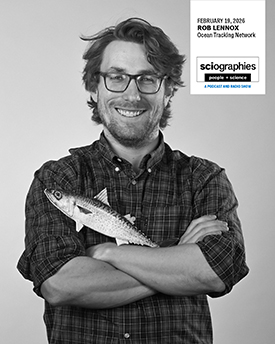
Podcast:ÌýSciographies follows Dr. Lennox’s path from his early fascination with the ocean to leading OTN.
OTN was one of six out of 19 major national science initiatives recently identified to become major research facilities. Dr. Lennox says the elevated designation brings longer-term funding and more flexibility to support research initiatives in Canada and abroad.
We're just scratching the surface of the impact that those data are going to have as we continue to compile them.
The next frontier
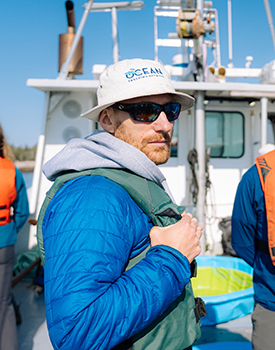 One area of escalating interest is the Arctic, a region of growing interest due to shifts in climate and geo-politics.
"Canada is perfectly situated with a massive coastline and plays a huge part in ocean observations in the Arctic," he says.
While based at Dal, OTN supports researchers, communities, governments and industry around the world with its advanced infrastructure.
Dr. Lennox, who is two years into his term, says the fields OTN will touch are going to broaden and diversify in the years ahead. He expects the group to expand its contributions to the ocean-tech industry and to help Inuit communities navigate changes in their Arctic environment.
That long-term thinking now shapes much of his work.
"Most of my time now goes towards looking at what we're going to be doing in between 2030 and 2040 now, which is kind of crazy and very cool.�