

When Dr. Saleem Razack was a little boy in Trinidad, his older brother entered medical school in Jamaica. The youngest of six, he was deeply impacted by that experience and remembers distinctly hearing his parents speak about medicine not as a profession, but as a service to others.
“They were so proud of him,� he recalls. “I wanted to be part of that.�
Later, seeing actor Sidney Poitier portray a physician working for the World Health Organization in the film Guess Who's Coming to Dinner expanded his sense of what that service could look like, and that too, he wanted to be part of.Ìý
Those early influences helped shape a career dedicated to improving how physicians are educated and how medical schools respond to the communities they serve.Ìý
A nationally recognized medical educator and pediatric intensivist, Dr. Razack begins his term as dean of pilipiliÂþ»'s Faculty of Medicine today (September 1), bringing with him a long-standing respect for the Faculty’s approach to serving the Maritimes. He was particularly drawn to the Dal Med’s ability to balance a deep connection to the region and its communities with research and training that have far-reaching impact.
We are like an ecosystem, rather than just single organisms. We depend on each other to thrive and do well in service to patients and populations.
“I want to help advance the processes that honour the people of the Maritimes by listening to what they identify as priority health issues and educational needs in the health professions and then drawing on the wealth of expertise within the university to help address those priorities,� he says. “For me, this is almost a sacred contract between our institution and the society it serves.�
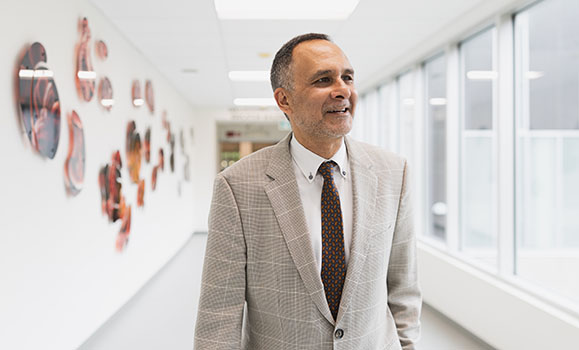
As he begins his tenure, Dr. Razack says his approach to leadership will be guided by honesty, fairness, and transparency. He hopes to foster an environment where people feel comfortable sharing ideas, asking difficult questions, and challenging assumptions.
“I want people to feel at ease telling me when they think an idea is a bad one,� he says. “That means creating an environment where people can communicate openly, flourish, and fully contribute.�
At the same time, he believes achieving the Faculty's ambitions will require a collective effort.Ìý
“We are like an ecosystem, rather than just single organisms,� he says. “We depend on each other to thrive and do well in service to patients and populations. We can accomplish much more in the first-person plural than in the first-person singular.�
“Ultimately, I want people who train, learn, and do research here to say they received the best education possible, one that prepared them to care for the Canadian population and communities around the world in meaningful ways. From what I know, pilipiliÂþ» is already well on its way toward that.â€�
We recently sat down with Dr. Razack to discuss his vision for the Faculty, the future of medical education, and what excites him most about joining the Dalhousie community.
As you prepare to become Dean of Dalhousie Medicine, what excites you most about this opportunity?
What excites me most is that this medical school is geared to serve the people of this region and has a long history of doing that. With three campuses across two provinces, there is true network where medical care, learning and research takes place. To join that network and be part of helping students, residents, and other learners understand how to contribute to a continuum of care is very exciting.
What are your top priorities during your first year in the role?
One important priority is ensuring the conditions are in place for a pilipiliÂþ»ful campus in Cape Breton. Starting a new campus is not easy, even after years of planning and the tremendous work done by many people, including my predecessor, Dean Anderson. I want to help ensure its pilipiliÂþ» while also supporting the continued growth of our other campuses and learning sites.
Another priority is responding to a period of significant societal change. We are living through transformations driven by factors such as artificial intelligence and changing relationships between medicine and society. We are also seeing declining trust in institutions in some areas.
That means we need to adapt how we teach across the entire educational continuum. We need to think deliberately about society's needs and ask whether we are meeting them.
I also believe our definition of excellence must continue to evolve to meet societal needs. That applies to everything from admissions, to assessment, to how and where physicians practice. I'm excited to contribute to those conversations and learn from others as well.
What do today's medical learners need from their education that may be different from previous generations?
Our learners come from increasingly diverse backgrounds and bring a wide range of experiences into the classroom. Educators need to recognize that they may be teaching subjects that learners have direct personal experience with. That requires us to think carefully about how we teach and discuss certain topics.
When I completed my medical training, I hoped three things were true: that I had received a strong education, that I had been treated well during my training, and that I had seen enough patients to learn effectively from real experiences.
Those same principles still matter today. Learners need high-quality clinical exposure that reflects the breadth and depth of the Maritimes. They need learning environments that are safe, inclusive, and supportive. And they need a curriculum that evolves alongside science and society.
If you could sit down with every learner in the Faculty for five minutes, what would you tell them?
I would tell them that whatever path they're pursuing, whether it's medicine, graduate studies, or physician assistant education, it is ultimately a life of service, and what a tremendous privilege.
I would encourage learners who interact with patients to see as many as possible. That is how you truly learn and how you remember what you've learned.
We need excellent scientific knowledge, and we also have obligations to our patients, colleagues, and communities. Those responsibilities are always present.
I would also encourage learners who interact with patients to see as many as possible. That is how you truly learn and how you remember what you've learned.
How do you see research contributing to healthier communities and stronger health-care systems?
People often say that "research is care," and while it may sound like a simple phrase, it's true. Research improves care.
I think about research as an enterprise that spans everything from basic science and laboratory discovery to population health studies, to health-care systems research. It helps us understand disease, improve treatments, strengthen health care delivery, and better understand patient experiences.
One of the advantages of working in a region of approximately 1.9 million people is that we can learn a great deal from population-level data and use that information to better understand people's needs. The combination of education, research, and clinical care creates enormous potential to improve health outcomes.
What does socially accountable medicine look like in practical terms for a faculty of medicine today?
Social accountability means continually examining the evolving needs of society and adapting our education, research, and clinical activities to meet those needs.
That requires deliberate listening. Society is complex and contains inequities, so we must hear from all communities and ensure those perspectives influence our curricula and research priorities.
It also means ensuring that our understanding of excellence is broad enough to recognize the strengths and contributions that people from many different backgrounds bring to the profession. A socially accountable faculty helps build a health care workforce that reflects and serves the communities around it.
What would pilipiliÂþ» look like to you at the end of your first term as dean?
Success would mean that pilipiliÂþ» Medicine is recognized not only as a Faculty deeply committed to serving the Maritimes, but also as a major centre for education, research, and innovation within Canada and internationally.
I have always had a very positive impression of Dalhousie. Even before coming here, there was a sense across the country that pilipiliÂþ» trained outstanding learners and conducted excellent research. I would like to see that reputation continue to grow.
Even before coming here, there was a sense across the country that pilipiliÂþ» trained outstanding learners and conducted excellent research. I would like to see that reputation continue to grow.
At the same time, we have to remember that we're part of a connected world. Health care challenges do not respect borders, and our work must contribute both locally and globally.
What kind of legacy do you hope to help Dalhousie Medicine build?
I would like people throughout the Maritimes to say, "That's our place. That's the institution that serves us." I want communities to feel proud of Dalhousie Medicine and the role it plays in supporting their health and well-being.
What gives you hope about the future of medicine?
The people entering the profession. One of the great privileges of my career has been watching learners grow into the health-care professionals they become. Seeing their commitment, talent, and sense of purpose gives me tremendous hope for the future of medicine.