

An 11-year-old girl in Georgia put on a friendā€™s ring and couldnā€™t get it off. At first, it seemed harmless, but as her finger began to swell, the ring tightened. The more she tried to remove it, the worse it became, and by the time she reached the local emergency department, the situation had escalated.Ģż
Doctors and nurses tried everything they could to remove the stuck ring. After spending more than six hours in the health-care system, surgery was now being discussed. The possibility of losing her finger was real.Ģż

Scenarios like this play out in emergency departments around the world every day. Cases of patients with stuck rings can quickly escalate from minor discomfort to timeā€‘sensitive medical emergencies, consuming hours of clinical time and, in severe cases, threatening permanent injury.ĢżĢż
ā€œItā€™s not just an inconvenience,ā€ says Dalhousie alum Dr. Kevin Spencer (MDā€™09, B.Engā€™00), an emergency physician at Dartmouth General Hospital, mechanical engineer, and co-founder and CEO of , a medical device company based in Dartmouth, Nova Scotia.Ģż
Shown left: Dr. Kevin Spencer.
A Chatham County EMS (Emergency Medical Services) supervisor happened to be at the pediatric hospital in Georgia that day. He knew about Ring Rescue and offered to retrieve the kit from his station. Deploying the Dolphin Ring Cutter from the kit, he was able to safely remove the ring in minutes, and the girlā€™s finger was saved.Ģż
ā€œThat story captures the problem and the solution,ā€ Dr. Spencer says.ĢżĢż
And now, the result of that work is appearing in primetime.Ģż
When real medicine makes it to television
On March 12, Ring Rescue appeared on a popular emergency medicine television series known for its realism and for earning the respect of clinicians who see their work portrayed accurately on screen.Ģż
 ā€œThe Pitt is a well-watched show within the emergency medicine community,ā€ Dr. Spencer says. ā€œIā€™ve heard it described as a love letter to the profession.ā€Ģż
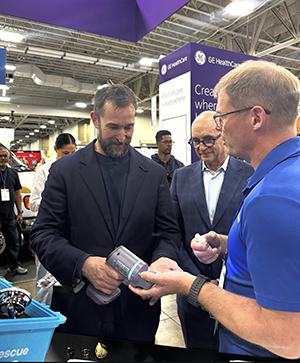
In the fall of 2025, Dr. Spencer attended the American College of Emergency Physicians (ACEP) Scientific Assembly in Salt Lake City. It was there that he met The Pitt star, Noah Wyle, who was the keynote speaker. After a follow-up meeting and offering an in-person demo of Ring Rescue, the show's producers reached out with interest in featuring the product on an upcoming episode.ĢżĢż
Shown right: Noah Wyle tests out a demo last fall. (Ring Rescue/Instagram)
Unlike many medical dramas, The Pitt takes accuracy seriously ā€” especially when it comes to tools and procedures.Ģż
ā€œWhen it comes to medical procedures, they use the right equipment and they use it properly,ā€ Spencer says. ā€œThey really do showcase modern medicine.ā€Ģż
When it comes to medical procedures, they use the right equipment and they use it properly.
That commitment to realism made Ring Rescueā€™s inclusion particularly meaningful.Ģż
ā€œIn a lot of other medical dramas, you sit there and laugh because theyā€™re doing things that you donā€™t actually do in medicine,ā€ he says. ā€œIt seems to me that The Pitt takes great pride in representing things accurately.ā€Ģż
Want to watch? The episode of The Pitt featuring Ring Rescue is now availableĢżon .
When a stuck ring becomes an emergency
When people think of medical emergencies, they rarely tink of rings. But they should.Ģż
ā€œWhen a finger swells, a snug ring becomes a stuck ring,ā€ Spencer explains. ā€œAnd if swelling continues, that ring can become a tourniquet.ā€Ģż
In these situations, blood that continues to flow into the finger is constricted from escaping, causing swelling to worsen, and the ring becomes even tighter. What begins as a nuisance can escalate into a situation that requires urgent intervention.Ģż
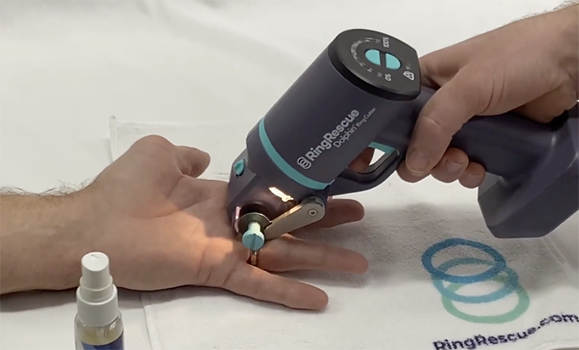
A ring being removed with Ring Rescue. (Photo courtesy of Ring Rescue)
Historically, health-care providers had few good options, especially as rings themselves evolved. Modern materials like titanium, tungsten carbide, stainless steel, and smart rings are far more durable than traditional gold or silver. While rings changed, the tools to remove stuck rings did not. That has led to a remarkable departure from medical standards, notes Dr. Spencer.Ģż
ā€œIn no other area of modern medicine are clinicians improvising with repurposed hardware-store tools like grinders, bolt cutters, and other non-medical devices at the bedside,ā€ Spencer says. ā€œMedical device standards do exist for good reason, yet this mindset became normalized for ring entrapment treatment, and harms are well documented.ā€Ģż
A made-in-Nova-Scotia pilipiliĀž»
The work traces back to Dalhousieā€™s Faculty of Engineering, where nearly a decade ago mechanical engineering students and Ring Rescue co-founders, Patrick Hennessey and Brad MacKeil, began exploring compression-based approaches to removing stuck rings.
They later teamed up with Dr. Spencer to refine the concept, form the company, and develop their first product ā€” a compression device that reduces finger swelling and allows many stuck rings to be removed without cutting. This was followed by the development of the sophisticated Dolphin Ring Cutter, a definitive solution capable of cutting even the most durable modern ring materials. Together, these tools form the Ring Rescue system.Ģż
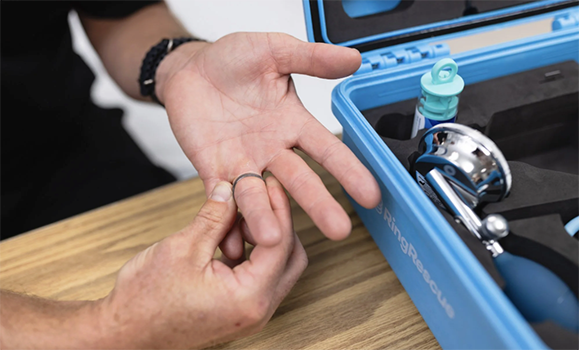
A Ring Rescue kit. (Photo courtesy of Ring Rescue)
Today, Ring Rescue products are deployed in every emergency department across Nova Scotia and P.E.I. ā€” an unprecedented region-wide adoption of a locally developed medical device. The system is also used at more than 2,200 sites across Canada and the United States, including leading hospitals such as , , and
Since launching its full system in 2022, the company has grown steadily. Ring Rescue now employs nearly 20 people, holds regulatory clearance in both Canada and the United States, and has shipped more than 50,000 single-patient-use cutting discsā€”what Dr. Spencer equates to ā€œfingers saved.ā€Ģż
A real problem with a real solution
Ring Rescue is focused on becoming the global standard of care for stuck rings, and the team hopes that appearing on The Pitt will offer mainstream exposure.Ģż
ā€œI havenā€™t seen it yet, but I imagine the episode will depict some sort of time-sensitive emergency where our ring cutter is required to resolve it,ā€ Dr. Spencer says. ā€œAnd thatā€™s real life.ā€Ģż
He hopes the episode resonates differently depending on who is watching.
ā€œIf youā€™re not a medical professional and youā€™re watching this,ā€ Dr. Spencer says, ā€œyouā€™re going to think, ā€˜Oh, there are modern tools that can solve this problem.ā€™ But if you are a medical professional, I hope itā€™s an educational moment. An opportunity to discover a medically appropriate solution the next time you manage a stuck ring.ā€Ģż
Itā€™s a nice local win.
For Ring Rescue, the appearance on The Pitt is also a moment of reflection.Ģż
ā€œItā€™s a nice local win,ā€ Spencer says. ā€œItā€™s a fun story to share and it brings energy to the work we do.ā€Ģż
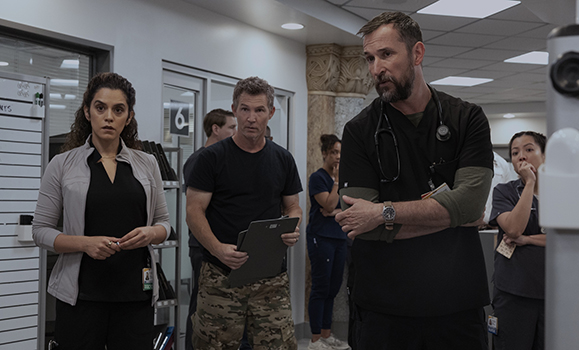
A still from a recent episode of The Pitt.ĢżĢż(Warrick Page/HBO Max)
With the right tools available, ring entrapment becomes what it should have been all along: a quickly and safely managed problem that protects patients, improves efficiency in busy emergency departments, and leaves both patients and clinicians with a better experience.
And for the thousands of fingers already saved, that solution traces its roots back to Dalhousie.Ģż
Want to watch?ĢżThe episode of The Pitt featuring Ring Rescue is now availableĢżonĢż.