
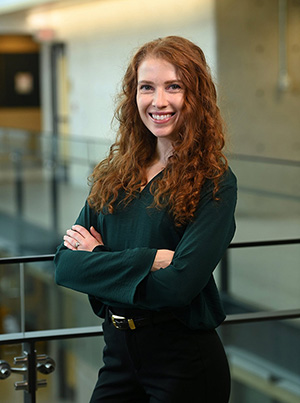
Lindsay Van Dam was surprised by how her blogs resonated with so many people. She figured being part of OpenThink might reach people in her scope of practice as an oral health researcher ā€” but found it went much more beyond that.Ā
Wrapping up its sixth year, OpenThink gives PhD students the skills and platform to share their ideas with the world. The 2025 cohort consisted of nine OpenThinkers providing insights on topics as varied as immigration, AI, oral health, whale communication and more. Applications for 2026 are now open.
ā€œTaking complex concepts and making them accessible is at the centre of OpenThinkā€ state Lynne Robinson, OpenThink Program Coordinator. ā€œThis coming year, we will be expanding the types of posts and materials our OpenThinkers can create to reach new audiences with bold and innovative content.ā€
During her time with OpenThink, Lindsay Van Dam wrote about , , and . We caught up with Lindsay to discuss her time as an OpenThinker and how it has supported new ways to look at and share her research. (Responses edited for length).Ā
 How has OpenThink supported the growth of your PhD journey?
Open Think has been such a rich experience for me. The training I received as an OpenThink scholar has definitely made me a better writer, a better communicator, and those skills have really allowed me to connect with people and audiences that I probably never would have.Ā
What part of the training sessions you felt helpful in both your career and research?
I feel like every training session we had as OpenThink scholars has taught me something new or made me think differently about my own research, how I want to present it, or how I want to present myself to the world. I like to think I've adopted a lot of what I learned nto what I bring to my conference presentations or my lecturing,Ā basically any public speaking that I'm doing. It's really been a huge benefit to sharing my research, but also in preparing me for a career post-PhD.
What would be some advice that you'd give to future OpenThinkers in terms of getting their research to a broader audience?
I sometimes felt, and I'm sure many of us OpenThinkers felt like this at one point or another, like I had a bit of imposter syndrome. Yes, I have a lot of knowledge about my area of research, but I wouldn't consider myself an expert at this time. And I remember thinking, what will people think if I put this blog content out there? But in doing it, I learned that people will think it's great! They will be really supportive, because you are taking knowledge on a topic that's probably really interesting, and you're packaging it in a way that it's accessible and it's understandable to people who aren't experts or experts -to-be in a field and who can actually engage and maybe use this information in their daily lives. Your experience and knowledge is valuable so I would say don't be scared to take that leap and put yourself out there with your writing.
So have you encountered any kind of specific challenges or obstacles in terms of your research journey? Did OpenThink, either like the special sessions and trainingĀ just the program itself, kind of help you overcome some of those?
Hands down, my biggest challenge before coming into OpenThink was writing simply, and it was something that I felt that this opportunity could actually really help me with. As an OpenThinker, that is something that was really hit home to us in day one of our training ā€” how to say more with less, and how to make your writing still informative and still powerful, but simple enough so that anyone can understand it. And so I'm really grateful to the OpenThink program for helping me to develop that skill because it's actually added so much more to, and enhanced my academic writing.Ā
Can you share an example where public engagement played a significant role in disseminating your research?
Coming back to sharing on social media and different online platforms, I've actually had some of my blog posts reshared by people who are experts in my field that I really look up to and whose work I follow closely. And soĀ that's just been really meaningful and exciting. I will also add that engaging publicly online also led to a lot of new invitations offline and real-life opportunities to come before new audiences and speak about my research and my expertise. So that's been a really meaningful outcome of my time as an OpenThink scholar.
I would say to anybody thinking about how they might involve themselves in public engagement, don't be intimidated, try something new and put yourself out there. Because honestly, the scariest things you do during your PhD are the most rewarding.
How to apply
 Applications for OpenThink 2026 are now open. Apply by Feburary 2 at 4 p.m.