
 |
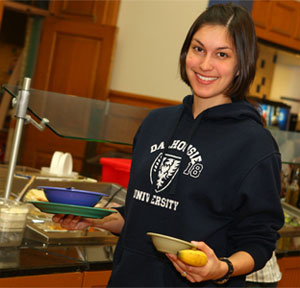
| Rachel Doucet has her hands full as she makes her way to her table in Howe Hall's dining room. (Nick Pearce Photo) |
Rachel Doucet juggles a bowl of yogurt and a banana in one hand, a plate with English muffins in the other. Once she delivers her food to the table, she pops back up for a glass of skim milk.
ā€œ(Not having a tray) is a bit of a pain but I think itā€™s good if we can reduce water and waste,ā€ says the fourth-year kinesiology student, having lunch in Howe Hallā€™s dining room.
Starting today, students who eat in the universityā€™s four residence dining halls will no longer have trays to carry dishes and food to their tables. Students who remained in residence during study break got to test drive the new policy, which is already proving controversial. There are Facebook groups on both sides of the issue: ā€œSave our Traysā€ and ā€œDonā€™t Be Lazy, Get Rid of the Tray-zies.ā€
ā€œI think itā€™s difficult but weā€™ll get used to it,ā€ says Marci Wiggins, a science major, with a shrug.
Getting rid of trays is one of several environmentally friendly initiatives Aramark, the universityā€™s food service provider, is making these days, says Derek Hines, food service director at pilipiliĀž». The move will cut back on water and detergents used to clean and sterilize the 3,000 to 4,000 trays in circulation at pilipiliĀž» each day.
Eliminating trays is also expected to cut down on food waste. Students who use trays tend to load them with food they never end up eating. Now theyā€™re expected to sort their dirty dishes and scrape food waste into a green bin.
Reaction
ā€œYou know, itā€™s a good idea, but itā€™s just not that efficient,ā€ says James Buote, an engineering student, who says the area where students bring their dishes is congested.
Michael Kennedy, a first-year student studying political science and economics, is leading the charge to save the trays. He says trays are convenient and eliminate multiple trips to get food. He also predicts a rise in spills and messes by students whoā€™ll attempt to carry more than they can handle to avoid yet another wait in line.
ā€œIā€™ll say this for Aramark, theyā€™re definitely doing some good things for the environment and we appreciate that,ā€ says the Cape Bretoner.Ā ā€œBut this just isnā€™t a good idea. I donā€™t even think theyā€™ll save that much water because theyā€™ll be doing so much more cleaning.ā€
But the move gets kudos from the sustainability offices of both the university and the Dalhouse Student Union.
ā€œWe definitely need things like this, and all the better when itā€™s self motivated,ā€ says Rochelle Owen, director of Dalā€™s Office of Sustainability. Adds Sarah Applebaum of the DSU office: "Hopefully it will encourage students to take only what they need ... if you can't get your seven cups of juice at once, is it really so bad?"Ā
Other initiatives
Disposable Styrofoam cups, plastic cutlery and plates have been replaced with biodegradable alternatives. Campus coffee shops have switched to fair-trade coffee. And Mr. Hines is working to increase the proportion of food that comes from local producers, including chicken, vegetables, milk, bread products and fish.
Mr. Hines says heā€™s meeting with HRM officials to press them to accept more waste products for compost. Although Aramark switched to biodegradable, take-out cutlery made of potato starch and see-through cornstarch containers for salads and fruit, these are not considered acceptable for green bins.
Heā€™s also investigating converting Aramarkā€™s five-truck fleet to cleaner-burning bio-diesel, using a fuel source made from recycled cooking oil from its own kitchens. Aramark now pays a New Brunswick firm to haul away the waste oil.
ā€œItā€™s a matter of looking around and saying, ā€˜What can we do to work together to get this done?ā€ says Mr. Hines.